Boundless

The day started off so well — exercise, a green smoothie, and a quick but satisfying pass through the newspapers.    

I could fill in some details, and maybe there was some kind of foreshadowing there.  The exercise, for example, was on a horse, which makes me sound grand.  Except I’m not.  The horse lives at a down market county park and while both he, the horse, and it, the park, are very beautiful, as was the day itself, the experience was not in the least bit fancy.  And the horse was recalcitrant, going wherever he felt like going.  You don’t have to know much about horses to know that the point of riding them is for them to go where you want them to go, not where they want to go.  

The green smoothie is a recent addition to my mornings, most of which, to be honest, I have skipped for the last few months.  The mornings, I mean, not the smoothies.  (But that is a story for another day — or a metaphor for my life right now).  I am very fond of fruit smoothes made with berries and peaches and several juices.  But I make the green ones with baby spinach and kale, and just a bit of fruit, and almond or coconut milk.  They are not as yummy as the ones made with fruit, of course, but they do have a nice crisp taste and the advantage of making one feel incredibly virtuous — all my vegetable servings before noon!  

Monday is a slow news day, so getting through the papers, while satisfying indeed, is not much of an accomplishment. But it did add to the virtuous nature of my morning.  

So vegetabled, caffeinated, and informed, I was ready to tackle my to-do list.  I used to make long to-do lists, on the theory that getting it all out on paper was a good thing.  But then I read that it’s not productive to look at a to-do list that is a full page long as it tends to discourage one from starting any task at all. The thing to do, according to the helpful article, was to make a very short to-do list, three or four items, and get them all checked off, providing one with a satisfying sense of accomplishment.

But the question I faced at the end of the day was this:  how depressing is it to have a to-do list that is only three items long — including “take a shower” — and have accomplished only one thing?  Not including take a shower? 


Winter Sun. Already.

As I walked down my driveway this afternoon, I just happened to turn around and look up at the sky — for no reason, you understand; there was no noise or sudden movement — and I saw the low winter sun light up the sugar maple across the street like fireworks, and just as swift.  The leaves sparked up yellow as bright as any spring buttercup, and then the gray clouds moved and the leaves were just yellow leaves on a tree with more bare branches than leafed ones.

It was heartbreaking, the way your heart breaks when you spend the day with an dear friend you haven’t seen in a while, and it’s so exciting at first and the words just rush on and on there’s so much to say and catch up on, and then there is that moment after a while when the conversation lags and you’ve said everything you can think of to say and you realize that however much you love your friend, she is not part of your life anymore, at least not the quotidian part, the part about the children and the annoying guy on your daily commute and your new fuschia sweater.  So you struggle on, dredging up dumb and pointless things to talk about, until it’s time to part.  And then you realize that there is still so much important stuff left to say, and that you will leave it unsaid.

It is November, after all.

In My Experience . . .

Experience matters.  But what do I know?

On the front page of yesterday’s New York Times, there was a story about the relatively short tenure of new teachers in charter schools.  The story included a quote that left me, in the words of my British friends, utterly gobsmacked:

“Strong schools can withstand the turnover of their teachers,” said Wendy Kopp, the founder of Teach for America. “The strongest schools develop their teachers tremendously so they become great in the classroom even in their first and second years.”  (http://www.nytimes.com/2013/08/27/education/at-charter-schools-short-careers-by-choice.html?pagewanted=all&_r=0)

To be fair, the article explains that new teachers in some charter schools receive a great deal of supervision, mentoring, and feedback, sometimes before they even set foot in a classroom.  Which is obviously a really good thing that undoubtedly makes them better teachers.  Of course, the article also says that studies show that a lot of teacher turnover has adverse affects on student achievement.

I’m not an education expert by any means, and I know very little about Wendy Kopp other than her Teach for America thing.  But as the mother of two children who’ve been educated in public schools for the last 12 years, I do have some thoughts about teachers.  Which basically come down to this:  experience in teaching is just like experience in any other field — it matters.

It’s not the last word on your value as a teacher.  Or your value as a lawyer, or a neurosurgeon, or a hedge fund manager, or a figure skater, or a supermarket cashier, or a journalist, or a mechanical engineer, or an architect, or a bus driver, or a real estate agent, or a groundskeeper at the U. S. Open, or the CEO of J.P. Morgan, or the Governor of New Jersey, or the Commissioner of Major League Baseball.

But there is a reason you want the lawyer arguing your case — whether it’s a case before the municipal court or the U.S. Supreme Court — to have some experience in litigation.  It’s the same reason you want your realtor to be a member of the “Top Sellers Club” (or whatever they call it), the reason that the Yankees have won more World Series than any other baseball team, and the reason you hire a real plumber, no matter how well your brother installed the laundry sink in his basement.

Sometimes, of course, long experience in a given profession just makes you cranky.  Everybody has a colleague who’s just phoning it in, no matter what field of endeavor you’re engaged in — teacher, bank manager, U.S. Senator, Sears clerk, parent.  Some people have a lot of experience and learn absolutely nothing from it.

Sometimes being new to your job means it’s easier for you to color outside the lines, to think outside the box, to bring a different perspective to a tough problem.  And some people are just geniuses at what they do right from the get-go, whether they are Mozart, middle-school teachers, or the guy who tiled my bathroom.  (Really.  He looked like a high school sophomore but he is a veritable artist with subway tile and grout.)

Mostly, though, in almost every field, we think experience is a good thing.  We think experience is a good stand-in for things like good judgment, maturity, and maybe even wisdom.  We know that experience isn’t a substitute for good judgment, or that you can be ignorant no matter how long you do something.  We know that energy, enthusiasm and creativity are not the exclusive purvey of the young.

But I think it is only when we talk about education reform that we say things like, “Strong schools can withstand the turnover of their teachers.”  What does that even mean?  Would we say that a baseball team with six rookies on the field is a better team than one with experienced players at all nine positions? Would you voluntarily fly across the country in an airplane staffed with pilots and officers who were all new to their jobs?  Study after study explains that going to the hospital in July, when all the new interns and medical resident arrive, raises your risk of dying by 10% or more.  Would you schedule your kid’s tonsillectomy in July because, hey, the strongest med schools develop their students tremendously so they can become great in the operating room in just a year or two?

All other things being equal — even though they never are — I’d put my child in a classroom with an experienced teacher instead of a first- or second-year teacher any day. And I bet Wendy Kopp would too.

Home

I have what can probably best be described as a completely primal sense of place.  I don’t think I can tell you what that actually means, but every summer,  my family spends a week in Lackawanna, NY, where my mom still lives in the same house I grew up in.

As my mother ages, I don’t suppose I need to explain why I take my family to visit every year.  Our stated reason has always been to go to the Erie County Fair, which just happens to be largest county fair in the country.  (I swear.  You could look it up.  The Erie County Fair has it’s own website.  And if I’m wrong about that, at least I’m pretty sure that it was at some point the largest county fair in the country.)

We  try to get to the Fair  in the morning, close to 10am when it opens, although obviously this gets harder as one’s children become teenagers and no longer experience morning unless forced to by state law or their mother.  Or sometimes ski season.  My husband always makes me swear we’ll leave before it closes at 11pm.  Sometimes we even do, but more often we do not.  Say what you will about Paris or New York, but to me, there’s nothing like seeing the lights go out on the James E. Strates Midway from the parking lot at the Fair.

I make my family look at the rabbits and the horses — they balk at checking out the cow and pig barns, but we do watch the Swifty Swine pig races.   There were a couple of years where we saw the lightweight horse pull, which is pretty cool; once we saw the heavyweight horse pull, which is actually mind-bending.  The kids and I go on the rides, although my husband does not.  They play carnival games, I Got It and the one where you squirt water into something’s mouth and sometimes The Wand.  I don’t like the games, but some years they win big. (And I have never been able to toss those stupid stuffed animals they won at the Fair, which is probably some kind of karmic payback for making them walk 200+ dusty acres in the August heat.)

We check out the RVs and hot tubs, and one year we drove a Toyota Tundra over an obstacle course.  Last year, I had vertigo and I did the Fair in one of those electric scooters that really old people ride.  (Tt was not a good experience.  Those things are much harder to drive that you think.)  This year, I had a “Free Fall Experience,” which involved climbing up 30 feet to a platform and jumping off into an absolutely gi-normous airbag.  My children have a video on their phones.  It was pretty fun.  (Obviously, the vertigo is completely gone.) Before we leave, we usually buy something from what my family calls the “Infomercial Building” and the Fair map calls the “Commercial Building” — rubber band guns, rigid plastic cones to scrape ice off your windshield, special iPhone cleaner (although, to its credit, it also works on jewelry and glasses).

The part of the Fair we all really look forward to, of course, is Fair food — roasted corn dunked into a bucket of melted butter, cheesesteaks, Italian sausage with onions and peppers, frozen cheesecake on a stick, ribbon fries, Chiavetta’s barbequed chicken dinners.  My daughter drinks gallons of Fair lemonade; we buy Fowler’s salt water taffy for my mom, who can’t come with us anymore (even in one of those scooters, and I am genuinely sorry I was so mean to her about her scooter driving skills) , and candied nuts for us to eat in the car on our way back to New Jersey.  We leave completely exhausted, usually with a bit of sunburn and a bit of nausea.  The good kind.  Not the vertigo kind.

When the children were younger, we spent a day at Fantasy Island too — more rides plus a water park.  (It’s a testament to how much my husband loves me that he participated, almost always with extremely good humor, in these excursions.)  I’ve started insisting on visiting  historical sites:  Fort Niagara, Our Lady of Victory Basilica, Frank Lloyd Wright’s Graycliff on Lake Erie.  We hang out with my high school friends, and it makes me feel complete in some weird way to say that my kids are friends with my high school friends’ kids.   We go to Fran-Ceil’s for frozen custard, real, full-fat custard in fantastic flavors like butterscotch and raspberry and pistachio.  We’ve gone to Niagara Falls, to the Anchor Bar to have chicken wings, and to Stratford, Ontario for the Shakespeare Festival.

My children used to play in the playground near my mother’s house, which was full of tall, dangerous and fun things made of steel that were too hot to sit on comfortably on an August afternoon — steep slides with no sides, towers 10 feet off the ground with old metal ladders, swings shaped like horses.  They replaced all the equipment there last year, with lower, safer, plastic coated things and rubber mulch to cushion a fall. It’s bright blue, and, to my daughter, tragic.

Lackawanna, as I think I’ve mentioned before, is a steel-town suburb south of Buffalo.  It is not beautiful, and frankly, it never was. We don’t go for the beauty, although it’s there if you can see it.  We go because I still have friends there.  We go because my mom is 86 years old.  But mostly we go because, even now, it’s my home.

Even now.  Even now that I have a bright and beautiful home of my own in an upscale New Jersey suburb. Even now that my life’s foundation rests firmly in the heart and soul of a good, good man who knows me well and loves me anyway.  Even now — or maybe especially now, almost 40 years after I stalked away from my parent’s house, from the red striped awnings, that big front window in the kitchen, and my father’s rock gardens, with a fierce and frantic desire to go somewhere – anywhere – else, anywhere else but this narrow little town with a close grey sky, a smoking corpse of a once-mighty steel plant, and no place for somebody like me who always felt so different from all the people who seemed so damned comfortable there.

Especially now.  Now that I know the world’s a much bigger place but often not that much less narrow. Now that I know that even the widest skies can be grey.  Now that I know that people are not always what they seem to be, and that comfort is given and taken but is not a destination.

Because life, after all, takes place  — at your mother’s kitchen table, on the Ferris Wheel at the Fair, in the church on the corner of Ridge Road and Center that was demolished years ago.  Lackawanna is my place. Like the pencil lines we make on the door jamb to mark our children’s growth, I go home every summer to mark mine.
In Memoriam: Wayne Randall, 1962-2013

For a blog that is supposed to be about how I live my 30,000 days, I seem to write a lot about death.  But, hey, I went to a funeral this morning.  For a friend.  Who was younger than me.  Who was strong and handsome and funny and generous and creative and kind.  And I am mad.

The minister at the service spoke about coming together to share our grief, which was nice, and about how good it was that our friend had “come home” to Christ, which was stupid.  Not because I’m not Christian, or because I don’t believe in God.  I do, actually, although why I do is a discussion for another day.  It was stupid because it so patently obvious that the guy was not ready to go home.  I hate it when people ignore the elephant in the room.

I went to a funeral for an old man once.  He had a lot of grandchildren, many of whom were in the church all somber and suited, looking for the life of me like some kind of surreal performance art.  Small children should never be dressed in a jacket and tie, just like you should never dress your cat in a nightgown and put him in a stroller.

Anyway, the priest asked them if they were angry that God had taken their grandfather and they gave a hesitant, scattered chorus of “yeses,” with some giggling and after a brief pause to make sure they really should answer out loud in church.  The priest said that it was OK to be angry with God, because God was not some wimpy thing that would blow away like a puff of smoke if you were mad at Him.  He said God was strong, and did things that human beings could not understand.  At all.  Like decide to take a beloved grandfather away from his family.

He said we should be angry. He said that God did things we did not understand.  He said that someday we might understand but maybe we would never understand and always believe that it was wrong and unfair.  He said that was OK, because we were human and God was divine.  He said you could be mad at God and still believe in His (or Her, if you prefer although the priest certainly didn’t mention that) goodness and mercy.

He did  not say that we should be glad that the old man had gone to his heavenly home.  He knew we were not glad and might never be glad.  So now my friend Wayne is with God, riding his motorcycle without a helmet and telling God all the good jokes and the best gossip and God is laughing his ass off and I am really pissed off.

Amen.


Saturday Morning

It piles up –

the unwashed dishes,

the undone laundry,

the organizing baskets and boxes unfilled and dusty –

and you swear you will always

wake up and look for the beauty in the world, but

all you see

are the unmade beds,

the stinking litter box,

the shoes the kids kicked off in front of the hall closet – WHY can’t they put them inside the closet, just a few damn inches, is it really that hard?  Do I ask too much? –

and it is so easy to not look 

at the sticky kitchen table,

the unopened mail with its attendant unpaid bills,

the plants with the browning leaves

and give it up to the hot gray day fetid with humidity and still as breath held,

no breeze to make the boughs of the trees move

like Russian ballerinas

with a heartbreaking near-perfect curve of shoulder elbow wrist fingers,

and only the swift straight line of the brown birds, the sparrows,

no bright flash of red cardinal or the arrogant bluebird or even

the shiny black slash of the crow, whose smooth feathers have always reminded me of my friend Kiki and her chin-length bob of 20 years ago, but could it really be 20 years?

and your life feels like an ocean

very very early on a very cloudy morning when you can’t separate water and sky

and you can’t see any damn beauty and

you don’t even want to get out of bed and look for it because your head

hurts and your left hip hurts, like it has for the past month,

and that is why, I think, that

sometimes I still read People magazine

so that I can distract myself from the fact that I swore that

I would always wake up and look for the beauty in the world. 

Home of the Brave

One of the participants in the Fourth of July parade in my medium-sized New Jersey town was a 90 year old man who was a veteran of the South Pacific theater in WWII.  The convertible in which he was riding listed his medals: a Purple Heart, two Silver Stars, two Bronze Stars, service awards….He was an old man, in his American legion cap, white haired and waving.  He was small and stooped.  If I’d passed him in the park, I would have assumed he was just another one of the little old men who take their very slow walks in the shade of the early morning or the early evening.  I would not have known that he was a brave man.

I was glad that he got to ride in the parade.  Glad that I got to sit on the curb in the shade of my friend’s big old house and cheer for the WWII vet.  I stood up when he went by, and cheered, and yelled and whooped for him.

He reminded me of my father, of course, who was also a WWII vet but did not live to be 90 or ride in any parades.  Like so many of his fellow vets, my father came home after the horrors of war and didn’t talk about what it felt like to be the bombardier in a B-24 in Italy in the last few years of the war.  He did talk about what it meant to be brave, though.  He said that being brave wasn’t like it was in the movies, and that courage wasn’t about being the biggest or the the strongest or the loudest but about being the one who did what he was sent out to do and who came home alive.  He said that being brave was about living through what you lived through, and that courage was about going home and living your life.

Which is what he did, along with many of his peers.  They came home and planted gardens, taught us how to play poker, and showed us what a family was for.  Like the veteran in the convertible in our parade, they were brave when it mattered and aged into the little old men in the park in the early evening.

It made me realize that we look into the faces of the brave every day, and we probably never realize that we do.   My friend in the big old house decided to hold her traditional Fourth of July party, even though her husband, who was the prime mover behind the annual bash, had died the month before.  She and her children decided that it would be sadder for them to watch the parade alone, or to spend the day in some other place, feeling wrong about where they were.  And when the old soldier went by and I stood up and cheered, I realized that the faces of the brave were standing right next to me.

Mothers and Sons

Yesterday morning, a senior at our high school stood in front of an oncoming train and died. He was 18.  I can’t stop thinking about his mother.

When my son was an infant, I used to sit in the rocking chair in his room and hold onto him long after he’d finished those 2am feedings.  I would hold his small small hand and think about how vast the world was, and about all the mean cold nasty things out there that could hurt him.  I used to weep over my baby boy and pray that God would protect him from all the horrible things that could happen to a small person in a big world.

Partly, I was hormonal.  Obviously.  Also partly I felt guilty — I absolutely positively hated beyond words and imagining being pregnant and I could not for the life of me understand how I would ever ever ever turn into someone’s mother.  Besides physically, I mean, and frankly, I had a bit of a hard time with that too. (HOW big is his head?)

I would sit with him and think about all the sad stories I’d ever heard about other people’s children dying young.  When I was pregnant there was a story in the newspaper about a six year old boy who was running for the school bus and fell, Superman style.  He had a small cut on his chin. He died the next day, because of some one-in-five-billion freak thing that can happen to your brain when you fall and hit your chin just right.  Before I ever even thought of having children, I had a colleague whose son had leukemia, which went into remission but returned when he was about 10. I went to the funeral and cried so much that I threw up.

My mother used to tell a story about her aunt who had two sons, or maybe three.  One died of something like a flu outbreak. The other got a job in one of the steel plants that operated in and around Buffalo.  It was the Depression; getting a job anywhere was a miracle.  His father, my mother’s uncle, worked at the plant too and helped him get the job.  He hadn’t been there very long when he was operating some kind of truck or cart that caught on fire; he couldn’t get off and he burned to death. My mother’s uncle was there in the yard when the fire started and watched his son die.  My mother always said that her aunt was never the same after that.

I held my baby and I cried about death by fire and cancer and freak accidents.  I cried about all the things that had hurt me when I was growing up — falling off bikes, burning my hand on the stove, the friends who turned mean for no reason and the boys that never liked me as much as I liked them. I cried about all the things I would do to keep my baby from harm — leap off buildings, run into fires, donate a kidney, starve to death, freeze to death….I cried about all the things that would hurt my son and all the things I could not protect him from.

My son is not a baby any more, and he is no longer small. He drives a car, wears a suit on special occasions and speaks in a deep voice. It isn’t hard to forget that the world is still very big and very cold.

I can’t stop thinking about that boy’s mother.  I think about all the bad things I imagined might happen to my son when I cried over him when he was a baby.  I think about saying, as mothers  everywhere must always say, that I would step in front of a speeding train for my children.  I am positive that the young man who died has a mother who would happily have thrown herself on the tracks to keep her boy safe. (And a father too, of course). But what is there to say if the thing that happens to your baby boy is worse than anything you ever imagined?  What do you throw yourself in front of when he goes and stands in front of the speeding train all by himself?  What is there to cry about then?

For Eamonn Wholley, I pray that God will give his restless soul a final rest. For Eamonn Wholley’s mother, I pray that whatever avenging God who would take her son from her this way will also have the mercy to grant her, and her husband and family, the strength and the grace to continue to live their lives without Eamonn in this cold and awful world.

What Moves Me

2013-05-29 11.31.03

My father was a bombardier in WWII, but I wasn’t thinking about him on Memorial Day.  I was thinking about soldiers and the price of freedom and all that, but not about my father. He’s been dead for over 20 years, and as I think of him less often now, I miss him less.  But that’s just because I’m not thinking about him.

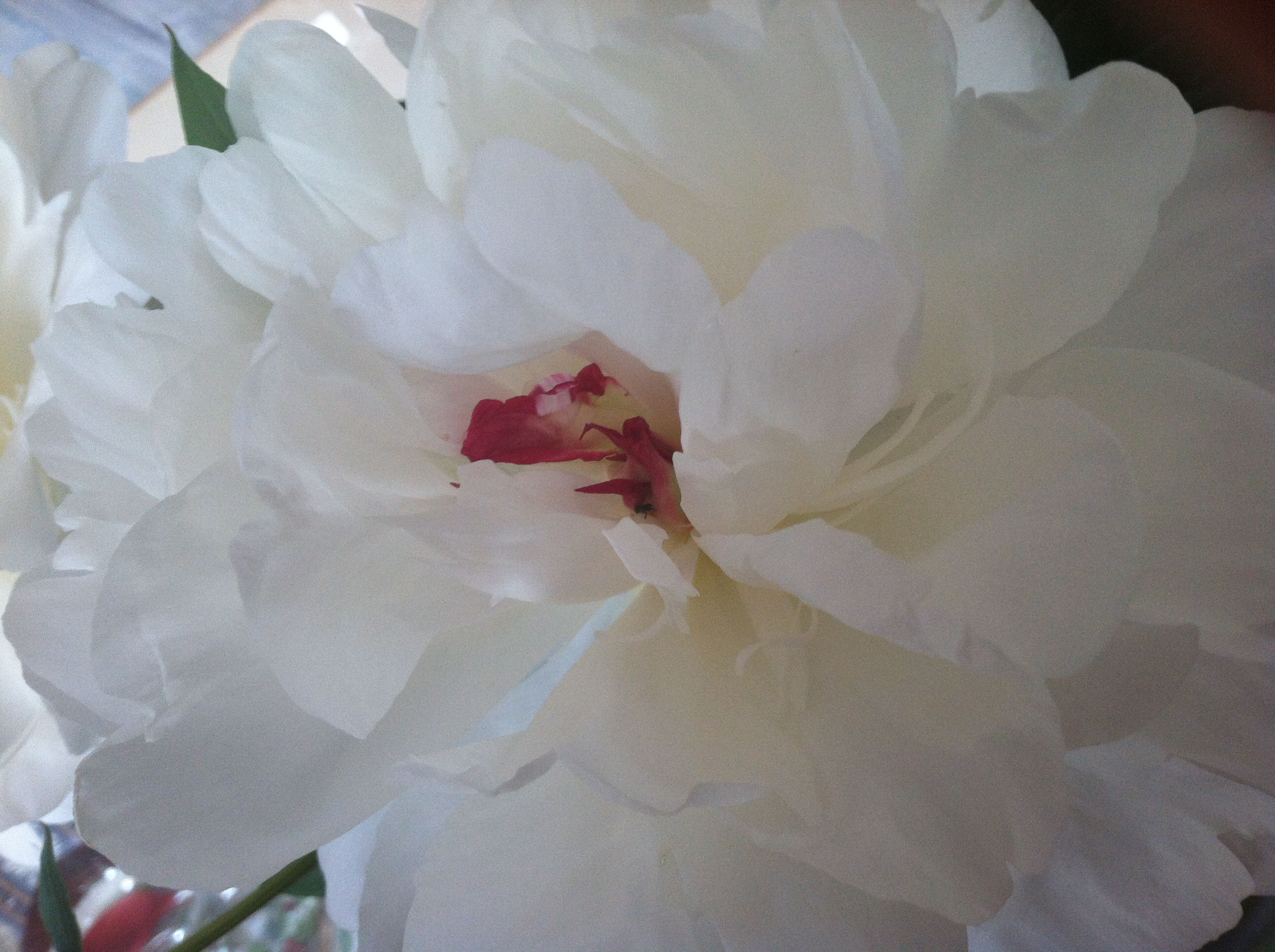
It’s funny, though, what moves you.  I spent a good part of the morning arranging seven shaggy white peonies in a white vase.  More time than I should have, really, what with the usual detritus of teenagers and middle age and a ridiculously old house piled around me like land mines.  The peonies came from bushes in my back yard, although I did not plant them.  I’m no gardener.

Peonies remind me of my father, who was quite a gardener.  I’m pretty sure he wished he was a farmer, but my mother was a city girl and there was absolutely no way she was going to live on a farm.  Maybe, if they were different people who lived different lives, my parents might have divorced and my father night have gotten himself a farm and a farm wife to go with it.  But they weren’t different people, and they weren’t unhappily married, and he never got more than our 1200 square foot back yard to farm.

Which he did.  My father loved his garden.  When I was growing up, we had an oval-shaped above-ground pool that we put up every spring, with much swearing, sweating and standing around holding that aqua blue plastic pool liner. But in the rest of the yard, my father dug beds — behind our house and on three sides of our detached garage — and every spring, he’d go out and turn over the dirt, sift out the weeds, and mix in wheelbarrows full of peat moss.  He planted beets and carrots, peppers and onions and scallions, lettuce, herbs and cucumbers and about a dozen different varieties of tomatoes, as soon as the danger of the last frost passed. (Not an idle danger, as we lived in Buffalo.)

He started the tomato plants in late winter, from seeds that he’d saved from the last of the tomatoes in the fall.  He stored the seeds in old pipe tobacco tins — round brown Amphora tins, with a little wing-nut shaped thing on the side that you turned to open them.  Around February, he’d plant the seeds in old coffee cans.  I think there was a point where he put the plants on a sunny windowsill in our kitchen, but eventually there were too many of them and he moved them into his workshop in our basement where he rigged up a grow light and some shelves.

They were usually the first thing he put them in the ground.  We had fresh tomatos from May to September — Early Girls and Big Boys, Brandywines and Red Ponderosas, plum and cherry. When I buy overpriced heirloom tomatoes in my A&P, I think of my father’s tomatoes with their uneven shoulders and knobby protrusions and variegated colors, dark green shading into dark red or the muddy mix of green, red, yellow.

And every evening, he would go out in the long summer dusk after dinner and tend to that garden.  He weeded and he watered and he checked for bugs.  He sprayed, but never chemicals only old-fashioned soap or soda ash solutions that he mixed up himself in the laundry sink.  He’d spend hours out there, pipe clenched between his teeth, in an old pair of shorts and even older pair of work boots, muttering to himself about beetles and soil quality.

We — my brothers and sister and I — hated that garden.  We hated the never-ending tomato supply. My brothers, turned into forced labor as soon as they could hold a shovel, hated the digging and hauling.  My sister and I hated the dirty lettuce that had to be washed five thousand times and then dried on long sheets of paper towels (which my Depression-era parents insisted that we hang over the kitchen chairs to dry and save), the cucumbers and carrots that bent or twisted and were so hard to peel.  We hated the beets, and we especially hated the beet greens that no one else on the planet — certainly no one in their right mind — ever ate.

My frugal mother, I think, liked the vegetables well enough; she was always pleased to save the grocery money.  But I am pretty sure that even she eventually resented the canning season, that point in early to mid-September when my father would bring in all the filthy, underripe stuff before the first frost. I remember the kitchen full of steam, from the sterilizing Mason jars in roasting pans and the pots of boiling water on the stove to plunge the tomatoes in to peel.  She chopped up all the onions and peppers and tomatoes and stewed them and lined up all the jars in the basement for us to complain about when she dragged them up to serve us in December and January.

The only thing I ever liked about my father’s garden was the flowers. He didn’t grow profusions of them, like he did the vegetables. Just one bed, with roses and peonies. Tall strong thorny rose bushes, with blood red and pale pinky-coral flowers, and in between them the floppy shaggy glossy-leaved pink peonies. He worked hard on the roses, fertilizing them and pruning them. I remember him railing against the shimmery Japanese beetles that ate perfectly round holes in the leaves. He must have loved them, because he broke his no chemicals rule for the beetles. But the peonies just grew.

Sometimes my father would bring some wonder from his garden into the house to show us, but generally we did not marvel at the odd-shaped carrots, or the tomato as big as your head.  We did not care for the smell of dill or the breath-freshening properties of parsley. Sometimes he would bring in a single peony flower with the stem cut very short, and float it one of the yellow melamine coffee cups we never used for coffee. In our un-airconditioned house in the summer, that one pink peony on the kitchen table would perfume the house with its slightly wistful sweetness.

I was thinking of my father while I arranged my peonies, bringing in his objects of wonder to his Philistine family.  About how much my father must have loved that garden and how much he must have wanted us to love the tomatoes and the beets.  About how much we didn’t care.  I think about the wonders that my father knew he could not show us, the wide wide world he’d caught a glimpse of during the war. The wide world that a mortgage and a family and a good steady job with good benefits shrank to a 1200 square foot back yard. I think about the wonders that he did show us — a good father and a loving husband, the alchemy of dirt and sun and sweat and patience and regular watering. The sweet scent of a single peony in an old plastic cup.    

Sheryl Sandberg and Me

Disclaimer:  I haven’t read Sheryl Sandberg‘s book, Lean In,” although I plan to.  (Seriously.) I have read a little about her book, although I am put in mind of my friend the late and very great journalist Marjorie Williams, who said that, as a general rule, advice about parenting from very rich women is not actually relevant to my life or any other ordinary person’s life. So when I tell you that I think Sandberg is right about women lacking the self-confidence or the willingness to lean into their careers, you have to take into account the fact that I know very little about what I’m talking about.

Not that I would let that get in the way of having an opinion.

With that said — I think Sandberg is right.  I think we as women do step back. We do tend to take the seat against the wall instead of at the table, and we certainly do not raise our voices. (Because we may wind up like New York City Council Speaker and mayoral front-runner Christine Quinn, with a front page story in yesterday’s The New Your Times about her “vicious” temper. For which she does not apologize. The hussy!)

I think Sandberg is right to encourage women to speak up, and to dream big, and to ignore the old notions of what it means to be a nice girl.  I think she’s right to encourage our husbands to take on more responsibilities at home, and to encourage our older male colleagues at work to become our mentors. (I don’t know if Sandberg mentions any of the other reasons women aren’t leaning in. Like not having access to high-quality childcare, strong public schools, rational mass transit systems, comprehensive health insurance, and a living wage.) I hope my teenagers, boy and girl both, will read the book and lean in until they fall over.

Here’s what I trip over, though: things don’t always work out the way you thought they would.

I used to lean in. And I was very lucky — I had everything Sandberg says women need to lead. Both of my parents, but my father especially, had the highest expectations for all their children, their two daughters as much as their two sons. I’m at the tail end of the baby boom, freed by my older sisters in the women’s movement from diminished dreams and lowered expectations.  I went to law school without enduring the scorn of professors or students, and graduated with job offers from some of the largest and most prestigious law firms in the country — unlike the former Supreme Court Justice Sandra Day O’Conner, who graduated from Stanford in the 1950s and was turned down by over 40 firms.  Partners at my firm encouraged my ambitions and all of my mentors were men. They treated me with tremendous respect and afforded me many opportunities.

Here’s an example. I worked with a partner on a big project for a Fortune 500 company.  At one point, the CEO summoned the partner to New York for a meeting. The guy said that I was coming too, at which the CEO balked.  My colleague told him that if he only wanted to meet with one lawyer, it should be me.  He said, “She’s the one who knows what she’s talking about here, not me.”  He totally stepped up for me.  And he wasn’t the only one.  My husband was then, as he is now, totally supportive. I was so totally going to make partner.

And then: biology.  I hated being pregnant. I was so unhappy I spoke with my doctors about resources for postpartum depression, certain that I would pose a threat to the baby and to myself.  But after he was born — and out of me! — I was absolutely flattened by this tsunami of love for my son (even though I didn’t know what a tsunami was at the time.) I went back to work after about four months but I was more interested in pumping breast milk than meeting with clients. The idea of being a partner in a law firm seemed as ridiculous to me as becoming a space alien.

I was sure I’d get over it.  I went to law school at night, and I worked so hard for my J.D. I was almost 40 when my son was born, and I’d been working since I was 16.  Why would I throw away that education? Who would I be if I wasn’t working? When our son was 18 months old, my husband was promoted and we moved to New Jersey.  I said I’d stay home for a couple of years.  I’d get settled, find childcare, figure out the logistics of living in a new place.

I never went back.  I couldn’t.  I didn’t want to.  I never thought I’d be the woman I’ve become, but I did.  Not because I gave in to society’s expectations.  Not because that’s all my parents ever thought I’d be.  Not because I didn’t have the right education or good mentors or a supportive husband.  Not because I was afraid to lean in.  But because I didn’t want to lean that way any more.

Sandberg says that success is making the best choices we can, and then accepting them. She’s right.