Mothers and Sons

Yesterday morning, a senior at our high school stood in front of an oncoming train and died. He was 18.  I can’t stop thinking about his mother.

When my son was an infant, I used to sit in the rocking chair in his room and hold onto him long after he’d finished those 2am feedings.  I would hold his small small hand and think about how vast the world was, and about all the mean cold nasty things out there that could hurt him.  I used to weep over my baby boy and pray that God would protect him from all the horrible things that could happen to a small person in a big world.

Partly, I was hormonal.  Obviously.  Also partly I felt guilty — I absolutely positively hated beyond words and imagining being pregnant and I could not for the life of me understand how I would ever ever ever turn into someone’s mother.  Besides physically, I mean, and frankly, I had a bit of a hard time with that too. (HOW big is his head?)

I would sit with him and think about all the sad stories I’d ever heard about other people’s children dying young.  When I was pregnant there was a story in the newspaper about a six year old boy who was running for the school bus and fell, Superman style.  He had a small cut on his chin. He died the next day, because of some one-in-five-billion freak thing that can happen to your brain when you fall and hit your chin just right.  Before I ever even thought of having children, I had a colleague whose son had leukemia, which went into remission but returned when he was about 10. I went to the funeral and cried so much that I threw up.

My mother used to tell a story about her aunt who had two sons, or maybe three.  One died of something like a flu outbreak. The other got a job in one of the steel plants that operated in and around Buffalo.  It was the Depression; getting a job anywhere was a miracle.  His father, my mother’s uncle, worked at the plant too and helped him get the job.  He hadn’t been there very long when he was operating some kind of truck or cart that caught on fire; he couldn’t get off and he burned to death. My mother’s uncle was there in the yard when the fire started and watched his son die.  My mother always said that her aunt was never the same after that.

I held my baby and I cried about death by fire and cancer and freak accidents.  I cried about all the things that had hurt me when I was growing up — falling off bikes, burning my hand on the stove, the friends who turned mean for no reason and the boys that never liked me as much as I liked them. I cried about all the things I would do to keep my baby from harm — leap off buildings, run into fires, donate a kidney, starve to death, freeze to death….I cried about all the things that would hurt my son and all the things I could not protect him from.

My son is not a baby any more, and he is no longer small. He drives a car, wears a suit on special occasions and speaks in a deep voice. It isn’t hard to forget that the world is still very big and very cold.

I can’t stop thinking about that boy’s mother.  I think about all the bad things I imagined might happen to my son when I cried over him when he was a baby.  I think about saying, as mothers  everywhere must always say, that I would step in front of a speeding train for my children.  I am positive that the young man who died has a mother who would happily have thrown herself on the tracks to keep her boy safe. (And a father too, of course). But what is there to say if the thing that happens to your baby boy is worse than anything you ever imagined?  What do you throw yourself in front of when he goes and stands in front of the speeding train all by himself?  What is there to cry about then?

For Eamonn Wholley, I pray that God will give his restless soul a final rest. For Eamonn Wholley’s mother, I pray that whatever avenging God who would take her son from her this way will also have the mercy to grant her, and her husband and family, the strength and the grace to continue to live their lives without Eamonn in this cold and awful world.
What Moves Me

2013-05-29 11.31.03

My father was a bombardier in WWII, but I wasn’t thinking about him on Memorial Day.  I was thinking about soldiers and the price of freedom and all that, but not about my father. He’s been dead for over 20 years, and as I think of him less often now, I miss him less.  But that’s just because I’m not thinking about him.

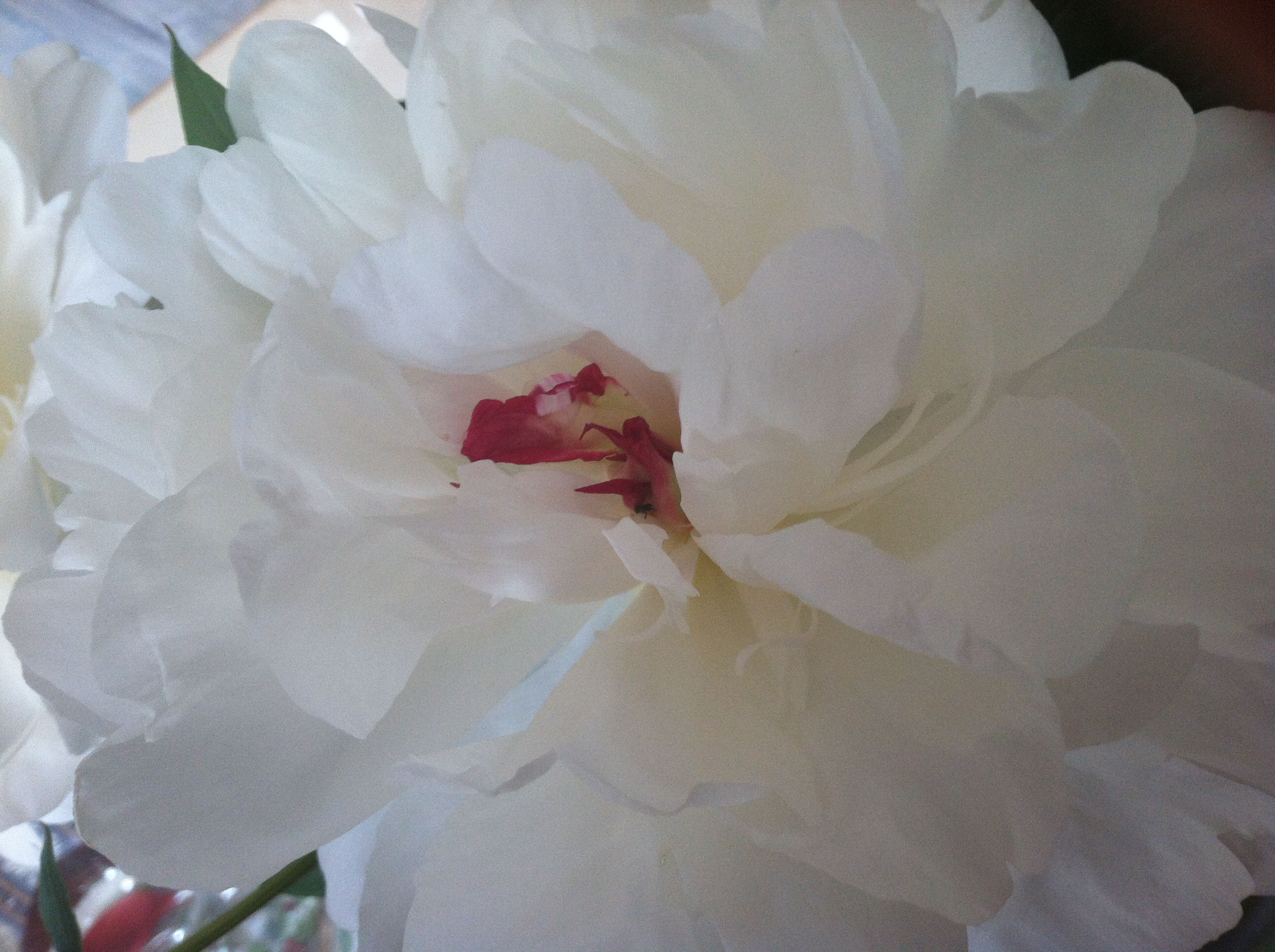
It’s funny, though, what moves you.  I spent a good part of the morning arranging seven shaggy white peonies in a white vase.  More time than I should have, really, what with the usual detritus of teenagers and middle age and a ridiculously old house piled around me like land mines.  The peonies came from bushes in my back yard, although I did not plant them.  I’m no gardener.

Peonies remind me of my father, who was quite a gardener.  I’m pretty sure he wished he was a farmer, but my mother was a city girl and there was absolutely no way she was going to live on a farm.  Maybe, if they were different people who lived different lives, my parents might have divorced and my father night have gotten himself a farm and a farm wife to go with it.  But they weren’t different people, and they weren’t unhappily married, and he never got more than our 1200 square foot back yard to farm.

Which he did.  My father loved his garden.  When I was growing up, we had an oval-shaped above-ground pool that we put up every spring, with much swearing, sweating and standing around holding that aqua blue plastic pool liner. But in the rest of the yard, my father dug beds — behind our house and on three sides of our detached garage — and every spring, he’d go out and turn over the dirt, sift out the weeds, and mix in wheelbarrows full of peat moss.  He planted beets and carrots, peppers and onions and scallions, lettuce, herbs and cucumbers and about a dozen different varieties of tomatoes, as soon as the danger of the last frost passed. (Not an idle danger, as we lived in Buffalo.)

He started the tomato plants in late winter, from seeds that he’d saved from the last of the tomatoes in the fall.  He stored the seeds in old pipe tobacco tins — round brown Amphora tins, with a little wing-nut shaped thing on the side that you turned to open them.  Around February, he’d plant the seeds in old coffee cans.  I think there was a point where he put the plants on a sunny windowsill in our kitchen, but eventually there were too many of them and he moved them into his workshop in our basement where he rigged up a grow light and some shelves.

They were usually the first thing he put them in the ground.  We had fresh tomatos from May to September — Early Girls and Big Boys, Brandywines and Red Ponderosas, plum and cherry. When I buy overpriced heirloom tomatoes in my A&P, I think of my father’s tomatoes with their uneven shoulders and knobby protrusions and variegated colors, dark green shading into dark red or the muddy mix of green, red, yellow.

And every evening, he would go out in the long summer dusk after dinner and tend to that garden.  He weeded and he watered and he checked for bugs.  He sprayed, but never chemicals only old-fashioned soap or soda ash solutions that he mixed up himself in the laundry sink.  He’d spend hours out there, pipe clenched between his teeth, in an old pair of shorts and even older pair of work boots, muttering to himself about beetles and soil quality.

We — my brothers and sister and I — hated that garden.  We hated the never-ending tomato supply. My brothers, turned into forced labor as soon as they could hold a shovel, hated the digging and hauling.  My sister and I hated the dirty lettuce that had to be washed five thousand times and then dried on long sheets of paper towels (which my Depression-era parents insisted that we hang over the kitchen chairs to dry and save), the cucumbers and carrots that bent or twisted and were so hard to peel.  We hated the beets, and we especially hated the beet greens that no one else on the planet — certainly no one in their right mind — ever ate.

My frugal mother, I think, liked the vegetables well enough; she was always pleased to save the grocery money.  But I am pretty sure that even she eventually resented the canning season, that point in early to mid-September when my father would bring in all the filthy, underripe stuff before the first frost. I remember the kitchen full of steam, from the sterilizing Mason jars in roasting pans and the pots of boiling water on the stove to plunge the tomatoes in to peel.  She chopped up all the onions and peppers and tomatoes and stewed them and lined up all the jars in the basement for us to complain about when she dragged them up to serve us in December and January.

The only thing I ever liked about my father’s garden was the flowers. He didn’t grow profusions of them, like he did the vegetables. Just one bed, with roses and peonies. Tall strong thorny rose bushes, with blood red and pale pinky-coral flowers, and in between them the floppy shaggy glossy-leaved pink peonies. He worked hard on the roses, fertilizing them and pruning them. I remember him railing against the shimmery Japanese beetles that ate perfectly round holes in the leaves. He must have loved them, because he broke his no chemicals rule for the beetles. But the peonies just grew.

Sometimes my father would bring some wonder from his garden into the house to show us, but generally we did not marvel at the odd-shaped carrots, or the tomato as big as your head.  We did not care for the smell of dill or the breath-freshening properties of parsley. Sometimes he would bring in a single peony flower with the stem cut very short, and float it one of the yellow melamine coffee cups we never used for coffee. In our un-airconditioned house in the summer, that one pink peony on the kitchen table would perfume the house with its slightly wistful sweetness.

I was thinking of my father while I arranged my peonies, bringing in his objects of wonder to his Philistine family.  About how much my father must have loved that garden and how much he must have wanted us to love the tomatoes and the beets.  About how much we didn’t care.  I think about the wonders that my father knew he could not show us, the wide wide world he’d caught a glimpse of during the war. The wide world that a mortgage and a family and a good steady job with good benefits shrank to a 1200 square foot back yard. I think about the wonders that he did show us — a good father and a loving husband, the alchemy of dirt and sun and sweat and patience and regular watering. The sweet scent of a single peony in an old plastic cup.